They already had gradual steps. And they definitely matter to home owners given by how much council time has been wasted on the changes over the years when somebody proposed a change to one.
So if you're set on R-C1. Then for a gradual change there is R-C1(s) which allows for suites. Then there's R-C1N for lot splits. And R-C1N(s) for a lot split with a secondary suite. And because R-C1 doesn't have the freedom of R1, you need R-C1L to have some rules about houses on a larger land parcel (and of course you'd need R-C1L(s) for that secondary suite, etc.
So what is it that you're actually proposing when you say 'gradual steps'? Gradual steps to what? Your neighborhood likely has a lot of those zoning types. Does everything get bumped up a bit? All R-C1 switches to R-C1(s) which switches to R-C1N(s) -> R-C2 -> R-CG -> M-1 and so forth? If I bought an R-C1 home, planned my life around it even, what are you proposing that becomes? Because I didn't buy R-C1 with the idea of lot splits or suites; if I wanted that I would have bought into an R-C1N(s) neighborhood.
'The consolidations do not matter' and 'just make gradual changes' are inherently incompatible positions, as the consolidations are a result of so many gradual steps being added over the years.
I did not say skip all consolidation, in fact I think I said go ahead with 90% of them, and I did not say take microscopic steps but more refined steps toward density than what the last council implemented.
For example: Merging the RC1s together is a lot less dramatic than merging the RC1s and RC2s into RCG. Then move that consolidated RC1 to a mid-point between RC1 and RCG. Taking gradual steps (without re-splitting the zoning) to make adoption more likely.
The reason to do this: If you cannot get buy-in for your idea and your idea gets repealed then what do you have?
I do not think this has been said yet but if you blow your first implementation with users it gets a LOT harder to bring back the same idea for a second implementation. After the blanket rezoning gets repealed it is going to be very hard to bring it back. That is not good.
If you treat the blanket rezoning as a project, then "repealing blanket rezoning" is the ultimate failure of the project. If I failed a project this hard, I would be hosting the biggest Lessons Learned session to understand all of the errors of the project and come back with a better plan to execute the next time (if there is a next time).
As for Westbrook, you're just advocating for the Vancouver and Toronto strategy. Towers and SFHs served by giant highways. No thanks. Westbrook and other TODs will come in time, but we can only build so many towers. There is clear and obvious demand for grade oriented infill.
No, what I am saying is that Westbrook is a huge black eye on getting user buy-in to the whole density emergency topic. Westbrook is not just a giant inner city empty field sitting between two major West-East arteries (Bow Trail and 17th Ave), it is also sitting on top of a train station!
How can you tell people that they have to suck it up and embrace the changes because "we need more houses" when they know that field could easily be a thousand homes? But we can't be bothered right now... It'll happen eventually.... No thanks.
It's funny that treating all low-density residential the same is "unfair", but picking socalled winners and losers would be more "fair".
It is the unimpacted communities that are raising the biggest fuss here. That's unfair to the rest of us who want a sustainable city.
My productive solution is the RCG should become max 4 dwelling units (2x2 or 4x1, whatever), with modifiers based on frontag. Set it so corner frontage would bump to 6 or 8, and 8-10 for an oversized lot. Use frontage minus side setbacks so that assembling adjacent lots results in bonus density, too.
But what they really need to take a look it is the land-use vs. development permit process. Council (and neighbours) have too much influence on land-use, and not enough on DP. A lot of the frustration here is misplaced from that process onto rezoning.
I’d like the development permit process to be simpler but tighter. Meet all zoning requirements and building standards and it’s automatic. Ask for deviations and the process should be soul-destroying and economically punitive. No more cute developer pushing the envelope games to get DC.
The Following 2 Users Say Thank You to edslunch For This Useful Post:
No, what I am saying is that Westbrook is a huge black eye on getting user buy-in to the whole density emergency topic. Westbrook is not just a giant inner city empty field sitting between two major West-East arteries (Bow Trail and 17th Ave), it is also sitting on top of a train station!
How can you tell people that they have to suck it up and embrace the changes because "we need more houses" when they know that field could easily be a thousand homes? But we can't be bothered right now... It'll happen eventually.... No thanks.
It feels pretty disingenuous.
Towers aren't for everyone. There's hundreds of great sites for towers all over the city. But there's no evidence that we're under-supplied. OTOH there's a reason its called the Missing Middle...
Why do the residents of Spruce Cliff and Shaganappi and Rosscarrock in the shadow of these eventual towers need to suck it up more than anybody else?
__________________
The UCP are trampling on our rights and freedoms. Donate $200 to Alberta NDP and get $150 back on your taxes
Towers aren't for everyone. There's hundreds of great sites for towers all over the city. But there's no evidence that we're under-supplied. OTOH there's a reason its called the Missing Middle...
Why do the residents of Spruce Cliff and Shaganappi and Rosscarrock in the shadow of these eventual towers need to suck it up more than anybody else?
First off, anyone living in the area knows that field is a problem. It often turns into a place for drug use and other problems. Developing the field will be welcomed as it will turn the space into something useful and populated instead of a space that you avoid.
Secondly, there are already 2 towers to the north (30 stories each?) and a C-Train station right there. It is the perfect location for the city to make a big statement about housing.
Also, the surrounding lots are already building to density or are not residential so the impact won't be significant:
- North side is Walmart parking lot, the Library and Bow Trail where the existing towers are and a golf course.
- To the east is the two new condo buildings behind the Corus building
- South side is 17th ave and then shops, bank, restaurants
- West has 4 old multi-unit buildings that honestly will get redeveloped once the surrounding area improves. Perhaps they could even be bought and incorporated into the larger project - if that happens then your West neighbours are the Emart, Liquor store, and Part Source who would all welcome more customers.
If you want to get spicy with it, I would (as the city) go get the Federal government grant for building affordable apartments and then make the entire site 'affordable' rentals. Make most of the buildings multi-bedroom (2-4) so that they can be feasible for family dwellings to supplement the missing middle housing. Also, by including 3+ bedroom apartments you are shifting out of the normal Calgary condo market and building replacements to the stand alone homes but without the maintenance of sidewalks, yards, etc.
Put retail on the main floor to cover off all essential shops and services that you would need for a population injection of that size (the federal grants have rules for the shops but do cover a big chunk of that cost too).
Have the city set up a non-profit to run the buildings and in one massive project you can build a huge injection of affordable housing for families that sits on top of the train line and also has bus routes that covers schools and other amenities.
I did not say skip all consolidation, in fact I think I said go ahead with 90% of them, and I did not say take microscopic steps but more refined steps toward density than what the last council implemented.
For example: Merging the RC1s together is a lot less dramatic than merging the RC1s and RC2s into RCG. Then move that consolidated RC1 to a mid-point between RC1 and RCG. Taking gradual steps (without re-splitting the zoning) to make adoption more likely.
The reason to do this: If you cannot get buy-in for your idea and your idea gets repealed then what do you have?
'Go ahead with 90% of consolidation, but also exclude about a third of the consolidations because that's too dramatic.' This just doesn't track. People evidently care a lot about a good chunk of the consolidations.
And I guess it's subjective but in what world is a mid-point between R-C1 and R-CG a "gradual step"? 1SFH vs 4 units w/ 4 suites would basically be taking all the R-C1x categories and making it R-C2(s). Is it your genuine opinion that the people in an uproar over losing their precious R-C1 status to more density wouldn't care as long as you just kept calling it R-C1? That just doesn't track.
On the plus side, it seems like you and powderjunkie are on the same page as their proposal is to just roll back R-CG for mid-block lots.
'Go ahead with 90% of consolidation, but also exclude about a third of the consolidations because that's too dramatic.' This just doesn't track. People evidently care a lot about a good chunk of the consolidations.
And I guess it's subjective but in what world is a mid-point between R-C1 and R-CG a "gradual step"? 1SFH vs 4 units w/ 4 suites would basically be taking all the R-C1x categories and making it R-C2(s). Is it your genuine opinion that the people in an uproar over losing their precious R-C1 status to more density wouldn't care as long as you just kept calling it R-C1? That just doesn't track.
On the plus side, it seems like you and powderjunkie are on the same page as their proposal is to just roll back R-CG for mid-block lots.
I think that if the RC1 communities were shifted to rules closer to RC2 instead of RCG then the backlash would have been less. There would have been some density gains (1 house lots can split to 2 and add suites) without the drama of a 8 plex (single lot) or a 34 plex (quad lot) in the middle of SFHs. Or, building 3-5 community-wide blanket rezonings and then applying them to applicable communities across the city would likely go over better than a city-wide rezoning. (I'm sure we could think of any number of ideas that could have landed better with the population)
But I also think the city had a lot more issues in implementing this change than just the details of the zonings.
I think the city did a poor job with stakeholder management and change management. They did not do enough to demonstrate how the people were going to benefit from the change. After years of fighting against home owners over changes to their homes the city was now bending over backward to allow developers to change whole communities and even as developers built more and more houses, prices were always going up. Even the public hearings did very little to win over people because the city did not make any significant adjustments after spending all of that time and money gathering feedback.
I mentioned this months ago but I think another factor worth mentioning is that the biggest 'winners' of the blanket rezoning are developers as they are not being inconvenienced in any way whatsoever and are being gifted huge opportunities to make profit. Having people feel inconvenienced, unheard, etc. and developers pulling significant profits is a bad combination to implementing a huge change.
The way people perceived these factors were not positive.
In the end, the change that was implemented was drastic enough, with very little good faith built up with the stakeholders, that the backlash influenced the results of the last election. Most of the incumbents lost their respective jobs and now the new city council is all about repealing.
I think there are a lot of valuable lessons in how this went.
It's that time of year again to bitch about property taxes and assessments. Looks like my assessment is down $25K this year and property tax should be up just over $50 this year.
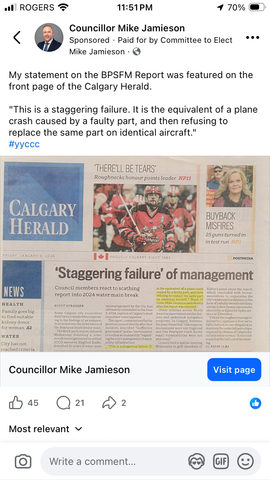
Is it fishy at all that Mike Jamieson is an elected official and is getting his Facebook posts promoted using his election campaign fund?
It's interesting because that's not the equivalent at all.
It's the equivalent of knowing the entire plane is structurally unsafe, and then needing to not only replace that plane, but all your other planes at the same time.
But then you are not allowed to just "ground" your plane/fleet at all, so you just have to keep going and hope for the best until you can actually replace the entire fleet at the same time.
I hate when people think that there's just easy solutions for everything.
The Following 3 Users Say Thank You to Regorium For This Useful Post:
LOL. How do these people function, let alone get elected?
Quote:
“My first reaction was, ‘Well, maybe that’s helpful,’” she said. “Maybe what we need to do is create a new agreement that reflects the reality of Red Deer not wanting to go to a blanket zoning position.
"We'd just like them to maybe ignore the rules of the funding agreement and still get the money."
On Dec. 15 when Calgary took the first step towards reinstating exclusionary zoning, Farkas said the feds were open to 'finding flexible solutions' (or something to that effect). Of course Farkas's first attempt at any kind of vague replacement was voted down. So odds are we're pissing away millions in March, too.
Toronto, Vaughan, and Tecumseh have all had some funding revoked, too.
__________________
The UCP are trampling on our rights and freedoms. Donate $200 to Alberta NDP and get $150 back on your taxes