12-21-2025, 01:36 PM
|
#29081
|
|
Franchise Player
Join Date: Mar 2007
Location: Income Tax Central
|
Agreed. We need to cram as many feckless miscreants as possible onto train cars as we can so they can keep the factories operating for the benefit of the Motherland.
__________________
The Beatings Shall Continue Until Morale Improves!
This Post Has Been Distilled for the Eradication of Seemingly Incurable Sadness.
The World Ends when you're dead. Until then, you've got more punishment in store. - Flames Fans
If you thought this season would have a happy ending, you haven't been paying attention.
|

|

|
|
12-21-2025, 04:38 PM
|
#29082
|
|
Franchise Player
Join Date: Oct 2014
Location: Springbank
|
The autobahn has some pretty horrific accidents, TBF.
|
|
|
|
|
12-21-2025, 04:45 PM
|
#29083
|
|
Franchise Player
Join Date: Mar 2007
Location: Income Tax Central
|
Quote:
Originally Posted by GioforPM

The autobahn has some pretty horrific accidents, TBF.
|
No way! I dont believe you. 
__________________
The Beatings Shall Continue Until Morale Improves!
This Post Has Been Distilled for the Eradication of Seemingly Incurable Sadness.
The World Ends when you're dead. Until then, you've got more punishment in store. - Flames Fans
If you thought this season would have a happy ending, you haven't been paying attention.
|
|
|
|
|
12-21-2025, 04:50 PM
|
#29084
|
|
Craig McTavish' Merkin
|
Quote:
Originally Posted by GioforPM
The autobahn has some pretty horrific accidents, TBF.
|
But it's still much safer than our highways are.
Quote:
|
Germany has a rate of around 4.3 fatalities on the road per 100,000 people, while Canada has closer to 6. Similarly, it has 2.7 fatalities per billion kilometres travelled, whereas the US has nearly double, with 4.5 fatalities. Two possible reasons behind this may be the difficulty and the cost involved in getting a German driver’s license, as well as the state of the roads themselves, which are well-maintained and even built in some places to withstand the weight of an airplane.
|
https://www.autotrainingcentre.com/b...hanic-courses/
|
|
|
|
|
The Following 4 Users Say Thank You to DownInFlames For This Useful Post:
|
|
|
12-21-2025, 04:52 PM
|
#29085
|
|
Franchise Player
Join Date: Jul 2010
Location: Calgary - Centre West
|

Quote:
Originally Posted by PepsiFree
“Just drive to conditions” OK a significant enough people don’t do that anyway or way overdo it so what difference doesn’t the speed limit matter?
“A greater speed differential” except as people get comfortable at 120 it’s just going to push the same speed differential to higher speeds and introduce a wider speed differential as some people just never get up to 120 because 100-110 was always good enough for them.
I get the arguments for it, truly. But you can’t just increase the speed limit. Improve the infrastructure (there are some stupid crossings, entries, and exits as it is that will only get more dangerous at greater speeds), improve driver training and testing (including moving licensing back under government control), and THEN we can talk speed.
Doing the last part first just means more, worse accidents.
|
The speed is already there. The data does not show that raising a speed limit to match traffic speeds simply shifts the entire distribution upward and preserves the same variance at a higher speed. What it shows is that when a limit better matches prevailing behaviour, the differential drops.
People who already felt safe at 120 were already there, they don't suddenly decide 130 feels fine because a sign changed. Meanwhile, a chunk of the 100-110 crowd does move up toward the flow, which narrows the spread. That reduction in speed differential is what lowers conflict between vehicles due to constant lane changes, tailgating, risky passing, and so on. One of the key takeaways from the Solomon Curve research is that crash involvement rises as a vehicle's speed deviates from the mean traffic speed, both above and below it. The outliers who ignore conditions exist regardless of the posted limit (ie: the typical RAM pickup driver), and that's an enforcement and licensing problem, to be sure -- but it's not a speed limit problem.
I agree wholeheartedly that infrastructure, access management (friggin' level crossings), and licensing (see: anyone with an O-plate and an Uber decal) need improvement, you'll get nothing but agreement from me there. But that's not an argument against aligning limits with reality... it is an argument for doing both. Waiting for perfect infrastructure before fixing a misaligned speed limit just means continuing to engineer unnecessary speed differentials in the meantime. Edge cases and bad drivers are exactly why you don't set limits based on worst-case behaviour.
__________________
-James
GO FLAMES GO.
Quote:
|
Originally Posted by Azure
Typical dumb take.
|
|
|
|
|
|
12-21-2025, 05:21 PM
|
#29086
|
|
Franchise Player
Join Date: Feb 2011
Location: Somewhere down the crazy river.
|
This should be fun. Presumably they’ll fix the Deerfoot potholes so we’re not all playing the swerve erratically at 120 or just hit them straight on game.
|
|
|
|
|
12-21-2025, 05:54 PM
|
#29087
|
|
Franchise Player
|
This is the challenge, people in general a really bad at understanding 2 variable problems, and traffic safety in general has 2 variables working in opposite directions.
the limited studies that do exist have shown that the modal driver will drive the speed at which they feel in control of the vehicle regardless of posted speed limits. Other studies have shown that variation in speed (faster or slower) is the greatest risk factor for increasing the frequency of incidents. And finally as is intuitive incidents are more severe at higher speeds.
Combine those facts and you find two different curves;
First is one where as you adjust speed limits closer and closer to the modal speed the road is used at, you see fewer and fewer incidents. This is because in general speeders are going to speed, but you get people in the 10th or 15th percentile that will drive at or below the posted speed limit regardless of what is safe or what others are doing around them, because of this when speed limits are set artificially low they create more variation in speeds on the roads, which increase the frequency of incidents.
The other curve is the intuitive curve, where as speeds increase incidents become less and less safe.
Where the safest point is where those two curves intersect. That is general understood to be the speed at which the 85th percentile vehicle is driving (85th percentile is where speeds usually tend to clump up and become the mode). I would argue that through most of highway 2, including in urban areas, the 85th percentile vehicle is travelling somewhere between 120 and 130, and setting the speed limits at that level would be the safest, probably 120 urban / curved and 130 rural / straight. What we should see is far fewer but more severe incidents that save lives, pain and money overall, but incidents that happen at a severity level that horrifies people and causes them to call for a return to crappier and less safe old system.
In an ideal world, I think we would see more dynamic speed limits. 130 rural/summer/day/dry.... maybe as low as 70 or 80 in heavy fog or snow, basically something that responds to the speed at which people should feel in control of their vehicles. That would the safest highways Alberta can offer us.
Speed doesn't kill, variation in speed kills, the safe way to use the road is to go the same speed as other people are going, and that's what the laws really should reflect. This is a well known convention that is most famously shown in the Solomon Curve.
https://en.wikipedia.org/wiki/Solomon_curve
Last edited by #-3; 12-21-2025 at 05:57 PM.
|
|
|
|
|
The Following User Says Thank You to #-3 For This Useful Post:
|
|
|
12-21-2025, 06:35 PM
|
#29088
|
Participant  |
Quote:
Originally Posted by TorqueDog
The speed is already there. The data does not show that raising a speed limit to match traffic speeds simply shifts the entire distribution upward and preserves the same variance at a higher speed. What it shows is that when a limit better matches prevailing behaviour, the differential drops.
People who already felt safe at 120 were already there, they don't suddenly decide 130 feels fine because a sign changed. Meanwhile, a chunk of the 100-110 crowd does move up toward the flow, which narrows the spread. That reduction in speed differential is what lowers conflict between vehicles due to constant lane changes, tailgating, risky passing, and so on. One of the key takeaways from the Solomon Curve research is that crash involvement rises as a vehicle's speed deviates from the mean traffic speed, both above and below it. The outliers who ignore conditions exist regardless of the posted limit (ie: the typical RAM pickup driver), and that's an enforcement and licensing problem, to be sure -- but it's not a speed limit problem.
I agree wholeheartedly that infrastructure, access management (friggin' level crossings), and licensing (see: anyone with an O-plate and an Uber decal) need improvement, you'll get nothing but agreement from me there. But that's not an argument against aligning limits with reality... it is an argument for doing both. Waiting for perfect infrastructure before fixing a misaligned speed limit just means continuing to engineer unnecessary speed differentials in the meantime. Edge cases and bad drivers are exactly why you don't set limits based on worst-case behaviour.
|
I believe the data actually does show that the variance can increase, though usually small, more often than it decreases. I don’t think your position is really evidence based. Here’s an example of a study that suggests the opposite: https://www.wisdomlib.org/science/jo...oc1774242.html
The “feels safe” argument doesn’t really do a good job of explaining the majority of behaviour. For one, if someone is going 120 in a 110, that may because it feels safe. It may also be because they’ve determined it to be a speed at which they are unlikely to get a ticket. Because traffic plays such a big role in “what feels safe,” if more people are suddenly going to go 120 instead of 110 (even though they determined for the same reasons that 110 was the speed for them, they’ll suddenly change their mind I guess), then going 130 will feel roughly the same as 120 did, so there’s little reason to stop people who were already speeding to speed even more.
But even if your argument were evidence based or some studies did show that, what almost all studies also show is a significant increase in crashes and, more importantly, fatal crashes. And even in the few older studies where crashes didn’t increase a lot, they did increased a lot around entires and exits. So it very much is a case where the infrastructure needs to come first. Otherwise all you’re doing is advocating killing more people so that you can drive to Edmonton 5 minutes faster. That sounds dramatic but it is the reality of the situation.
|
|
|
|
|
12-21-2025, 07:55 PM
|
#29089
|
|
Franchise Player
Join Date: Mar 2015
Location: Pickle Jar Lake
|
Quote:
Originally Posted by #-3
This is the challenge, people in general a really bad at understanding 2 variable problems, and traffic safety in general has 2 variables working in opposite directions.
the limited studies that do exist have shown that the modal driver will drive the speed at which they feel in control of the vehicle regardless of posted speed limits. Other studies have shown that variation in speed (faster or slower) is the greatest risk factor for increasing the frequency of incidents. And finally as is intuitive incidents are more severe at higher speeds.
Combine those facts and you find two different curves;
First is one where as you adjust speed limits closer and closer to the modal speed the road is used at, you see fewer and fewer incidents. This is because in general speeders are going to speed, but you get people in the 10th or 15th percentile that will drive at or below the posted speed limit regardless of what is safe or what others are doing around them, because of this when speed limits are set artificially low they create more variation in speeds on the roads, which increase the frequency of incidents.
The other curve is the intuitive curve, where as speeds increase incidents become less and less safe.
Where the safest point is where those two curves intersect. That is general understood to be the speed at which the 85th percentile vehicle is driving (85th percentile is where speeds usually tend to clump up and become the mode). I would argue that through most of highway 2, including in urban areas, the 85th percentile vehicle is travelling somewhere between 120 and 130, and setting the speed limits at that level would be the safest, probably 120 urban / curved and 130 rural / straight. What we should see is far fewer but more severe incidents that save lives, pain and money overall, but incidents that happen at a severity level that horrifies people and causes them to call for a return to crappier and less safe old system.
In an ideal world, I think we would see more dynamic speed limits. 130 rural/summer/day/dry.... maybe as low as 70 or 80 in heavy fog or snow, basically something that responds to the speed at which people should feel in control of their vehicles. That would the safest highways Alberta can offer us.
Speed doesn't kill, variation in speed kills, the safe way to use the road is to go the same speed as other people are going, and that's what the laws really should reflect. This is a well known convention that is most famously shown in the Solomon Curve.
https://en.wikipedia.org/wiki/Solomon_curve |
I don't really buy the argument speed variance will narrow, because the people driving 90 with the speed limit at 110 are not going to go any faster if the speed limit is 130. This could be driver confidence or just vehicle capability or restrictions like School buses.
The bold bit is basically saying this, but you add "artificially low" to rationalize the point, when I'm not convinced that is the case on our highways. So if isn't artistically low, and just in the middle of the speed range window(which I suspect it is) then you will get greater variance. Add in some of the big hills where trucks and RV's really slow down and the variance increases more, particularly if the merge zone is uphill like eastbound TCH at Cochrane. Then you get a slow first vehicle, and someone impatient behind pulling into the middle lane, and it's only going to be far more dangerous if the fast lane is 130.
The problem with variable limits and ####ty enforcement is people will decide to drive at the speed they have driven it before. Variable is fine, but you need something like UK type speed cameras to ensure it.
|
|
|
|
|
12-21-2025, 08:14 PM
|
#29090
|
|
Franchise Player
Join Date: May 2016
Location: ATCO Field, Section 201
|
@wormis
Is there anything suggesting they will raise the speed limit in cities? My understanding is that this is for rural sections of the highways.
|
|
|
|
|
12-21-2025, 08:30 PM
|
#29091
|
|
Franchise Player
Join Date: Feb 2011
Location: Somewhere down the crazy river.
|
Quote:
Originally Posted by TheIronMaiden
@wormis
Is there anything suggesting they will raise the speed limit in cities? My understanding is that this is for rural sections of the highways.
|
I thought the trials were only rural sections. But in either case, are the potholes only bad in Calgary city limits? I guess the roads might improve in the outskirts.
|
|
|
|
|
12-21-2025, 10:30 PM
|
#29092
|
|
Franchise Player
|
Quote:
Originally Posted by Fuzz
I don't really buy the argument speed variance will narrow, because the people driving 90 with the speed limit at 110 are not going to go any faster if the speed limit is 130. This could be driver confidence or just vehicle capability or restrictions like School buses.
The bold bit is basically saying this, but you add "artificially low" to rationalize the point, when I'm not convinced that is the case on our highways. So if isn't artistically low, and just in the middle of the speed range window(which I suspect it is) then you will get greater variance. Add in some of the big hills where trucks and RV's really slow down and the variance increases more, particularly if the merge zone is uphill like eastbound TCH at Cochrane. Then you get a slow first vehicle, and someone impatient behind pulling into the middle lane, and it's only going to be far more dangerous if the fast lane is 130.
The problem with variable limits and ####ty enforcement is people will decide to drive at the speed they have driven it before. Variable is fine, but you need something like UK type speed cameras to ensure it.
|
The speed limits are set artificially low because a plurality of people feel safe and confident in using the roads faster (again I do specify in normal conditions, and I do specify that variable speed limits with conditions would be optimal for almost any circumstance).
The idea that variance in speed is lower when you set speed limits to the modal speed that roads are used at isn't a baseless opinion. There have been 2-3 studies done on it and that is consistent with their findings, although because speed limits aren't set by researchers, they were natural experiments, and generally considered weak, there just aren't studies that say the opposite, critiques of those studies are based on the methodology not the substance.
And I really am only specifically referring to uncongested highway conditions on multi lane roads. It's an important distinctions, because urban roads have other factors such as pedestrians, starts/stops, frequent entries/exits... and congested highway conditions render the speed limits moot. and single lane roads create blockages on speed variations (in so much as people will drive no faster than the guy in front of them, until they can pass, so so they are natrually just going the same speed.).
|
|
|
|
|
The Following User Says Thank You to #-3 For This Useful Post:
|
|
|
12-22-2025, 09:41 AM
|
#29093
|
|
Franchise Player
|
Increasing the speed limit on the QE2 without adding lanes would be idiotic. You’ll have semis passing nervous drivers in the right lane while being tail-gated by drivers in the left lane still trying to do 20k/h over the new limit. It would be an even worse ####-show than it is now. You need at least three lanes (and ideally four) each way to handle that kind of speed variance on a busy road with lots of commercial vehicles.
__________________
Quote:
Originally Posted by fotze
If this day gets you riled up, you obviously aren't numb to the disappointment yet to be a real fan.
|
|
|
|
|
|
12-22-2025, 09:48 AM
|
#29094
|
|
Franchise Player
|
Quote:
Originally Posted by Fuzz
I don't really buy the argument speed variance will narrow, because the people driving 90 with the speed limit at 110 are not going to go any faster if the speed limit is 130. This could be driver confidence or just vehicle capability or restrictions like School buses.
|
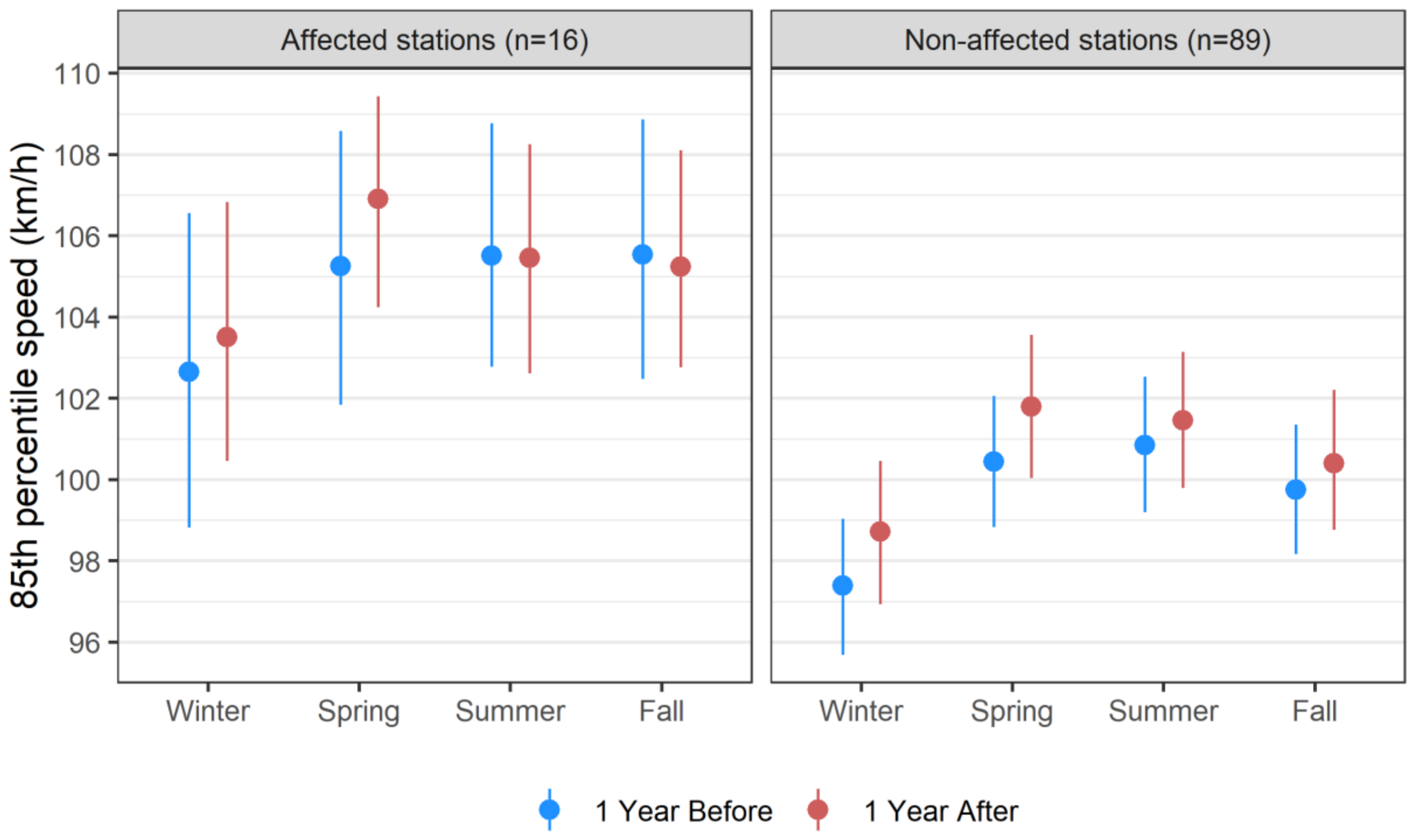
You just recently posted a link to a CBC article about increased crashes with higher speed limits and that that article also referenced a study on safety that was done regarding the speed limit changes. That study looked at differentials and the those did actually narrow on the roadways where the speed was increased. You can see the red bars on the left chart are shorter than the blue bars meanwhile the red bars on the right chart are approximately equal to the blue bars.
|
|
|
|
|
12-22-2025, 09:53 AM
|
#29095
|
|
Franchise Player
Join Date: Mar 2015
Location: Pickle Jar Lake
|
Quote:
Originally Posted by #-3
The speed limits are set artificially low because a plurality of people feel safe and confident in using the roads faster (again I do specify in normal conditions, and I do specify that variable speed limits with conditions would be optimal for almost any circumstance).
The idea that variance in speed is lower when you set speed limits to the modal speed that roads are used at isn't a baseless opinion. There have been 2-3 studies done on it and that is consistent with their findings, although because speed limits aren't set by researchers, they were natural experiments, and generally considered weak, there just aren't studies that say the opposite, critiques of those studies are based on the methodology not the substance.
And I really am only specifically referring to uncongested highway conditions on multi lane roads. It's an important distinctions, because urban roads have other factors such as pedestrians, starts/stops, frequent entries/exits... and congested highway conditions render the speed limits moot. and single lane roads create blockages on speed variations (in so much as people will drive no faster than the guy in front of them, until they can pass, so so they are natrually just going the same speed.).
|
I get what the studies and stats are saying, but I think when you mention:
"but you get people in the 10th or 15th percentile that will drive at or below the posted speed limit regardless of what is safe or what others are doing around them"
is always going to increase the potential for hazardous speed variance. Sure variance amongst the rest of the vehicles on the road may narrow. But these outliers are the dangers. The slowest of drivers will now be 10% slower than the rest of traffic, because they don't adjust their speed. Does that make sense as to why it would be more dangerous, despite the average variance perhaps reducing?
|
|
|
|
|
12-22-2025, 11:10 AM
|
#29096
|
|
Franchise Player
Join Date: Mar 2007
Location: Income Tax Central
|
Speed doesnt kill..its the suddenly becoming stationary that gets you.
__________________
The Beatings Shall Continue Until Morale Improves!
This Post Has Been Distilled for the Eradication of Seemingly Incurable Sadness.
The World Ends when you're dead. Until then, you've got more punishment in store. - Flames Fans
If you thought this season would have a happy ending, you haven't been paying attention.
|
|
|
|
|
12-22-2025, 11:22 AM
|
#29097
|
|
Franchise Player
Join Date: Feb 2011
Location: Somewhere down the crazy river.
|
Quote:
Originally Posted by Locke
Speed doesnt kill..its the suddenly becoming stationary that gets you.
|
I think flipping a few times at any speed can be bad for the body.
|
|
|
|
|
12-22-2025, 11:24 AM
|
#29098
|
|
Franchise Player
Join Date: Mar 2007
Location: Income Tax Central
|
Quote:
Originally Posted by Wormius
I think flipping a few times at any speed can be bad for the body.
|
Pfft...if that were true Gymnasts would be perishing at an alarming rate and trambampoline parks would have outrageous insurance premiums. 
__________________
The Beatings Shall Continue Until Morale Improves!
This Post Has Been Distilled for the Eradication of Seemingly Incurable Sadness.
The World Ends when you're dead. Until then, you've got more punishment in store. - Flames Fans
If you thought this season would have a happy ending, you haven't been paying attention.
|
|
|
|
|
12-22-2025, 11:26 AM
|
#29099
|
|
First Line Centre
|
Quote:
Originally Posted by Locke
Speed doesnt kill..its the suddenly becoming stationary that gets you.
|
Unless you get T-boned by a car going 150 while trying to cross the highway to turn left from a stop sign intersection. Then speed is killing you, the other driver, and all of the passengers.
I really do not think the ROI is there on this change. More risk, likely more fatalities, just so some people can have a heavier foot on the gas pedal?
The trade off between FREEDUMB and killing people doesn't add up.
More fatalities possible if province raises speed limits on highways, warns motor association
Quote:
|
It found that a five mile-per-hour climb in speed limits was associated with eight per cent more fatalities. It attributed more than 37,000 deaths in the U.S. over the previous 25 years to looser constraints, adding 1,934 people “would still be alive if speed limits hadn’t changed since 1993.”
|
Stoney Trail already has problems with kids going on there and treating it like a race track... but even without that, the speeds lead to pretty scary accidents:
https://www.reddit.com/r/Calgary/com...n_dead_stoney/
I get the argument from the UCP perspective. They don't care if people die as long as we stop talking about toppling the government or closely looking at the terrible things they are doing.
I don't really get the argument from anyone else.
|
|
|
|
|
12-22-2025, 11:29 AM
|
#29100
|
|
Franchise Player
|
Quote:
Originally Posted by Fuzz
I get what the studies and stats are saying, but I think when you mention:
"but you get people in the 10th or 15th percentile that will drive at or below the posted speed limit regardless of what is safe or what others are doing around them"
is always going to increase the potential for hazardous speed variance. Sure variance amongst the rest of the vehicles on the road may narrow. But these outliers are the dangers. The slowest of drivers will now be 10% slower than the rest of traffic, because they don't adjust their speed. Does that make sense as to why it would be more dangerous, despite the average variance perhaps reducing?
|
Fair enough, I think a lot of people feel that way. But I just think as a society in general we lean too far towards villainizing speed as an issue, without looking that the problems created by drivers in the 10th -15th percentile range of speed on the road.
And as mentioned before, higher speed limits generally tend to create narrow outliers based on natural experiments that have been measured. So to answer your question, what evidence we have says that when you raise the speed limit, the slowest vehicles go more faster, and the fastest vehicles go less faster.
And I really do believe in the concept that rather than slow being safe, narrow variation is safe. Maybe I am wrong, but there are also weak natural experiments that support that belief.
|
|
|
|
|
The Following User Says Thank You to #-3 For This Useful Post:
|
|
| Thread Tools |
Search this Thread |
|
|
|
 Posting Rules
|
You may not post new threads
You may not post replies
You may not post attachments
You may not edit your posts
HTML code is Off
|
|
|
All times are GMT -6. The time now is 05:38 AM.
|
|