Quote:
Originally Posted by Pinner

Here's a pie chart (from a different site) with pretty much the same info, Human's contribute 0.28% of total Greenhouse gases, only a portion of that would be CO2.
(If I understand it) 
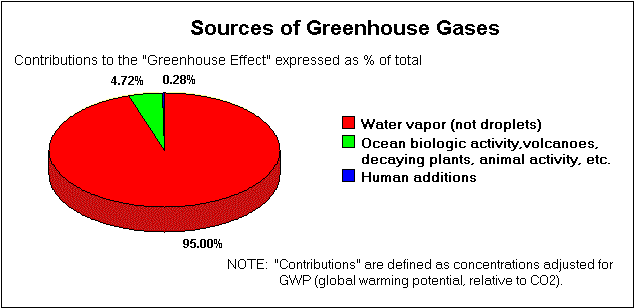 |
I'd question how they got to their numbers, they say "concentrations adjusted for global warming potential", but I'll assume they're right for now. But it seems they just wanted to make a graph which implied a message that human CO2 is nothing compared to everything else. If one didn't know the context of that info, then they'd draw the wrong conclusion.
I already gave the answer for how much CO2 in the global cycle was man-made, so lets look at how much man made CO2 impacts the global mean energy budget.
Incoming solar radiation is 342 Wm-2 (W per square meter). Of that the "radiative flux" or greenhouse effect for water vapor is 72Wm-2, and CO2 accounts for 32Wm-2. This means that rather than being radiated back into space, that much gets kept back, either reflected back to earth, or heating the atmosphere itself.
http://coelho.mota.googlepages.com/RadiationBudget.pdf
So I'm not sure what the graph is trying to say, but the amount of energy being retained (greenhouse) due to water vapor and CO2 are in a 2:1 ratio, not 100:1.
Plus, water vapor isn't a greenhouse gas in the same way that CO2 is.. CO2 is an external forcing, CO2 is added to the atmosphere by external sources.. breathing, burning fossil fuels, living, etc. Water vapor in the atmosphere is added by evaporation constantly, depending on the air and water temperature. The water vapor isn't forced into the air like CO2, it's drawn in [b]or removed[b/] based on the conditions of the air itself. All things being equal, the amount of water vapor in the air will remain constant. More evaporates here, it's removed later by rain or snow. Air gets dry, more water is sucked up via evaporation. All things being equal, it stays in balance.
But not all things are equal, the balance can be upset.. if the air gets warmer, it will absorb more water vapor. That's why water vapor is a positive feedback mechanism, any warming factor is amplified because of the positive feedback of water vapor.
How much feedback? By itself, doubling CO2 would increase global temperatures by about 1 degree. With water vapor feedback, that doubles to 2 degrees. With the other feedbacks like albedo change, doubling CO2 would increase temperatures by 3 degrees.
So back to the original question, radiative forcing due to CO2 total is 32Wm-2, and man's component of that is something like 1.6Wm-2
http://en.wikipedia.org/wiki/File:Ra...e-forcings.svg