When you think about pirates, you think about a lot of the famous 16th and 17th century Caribbean pirates, but obviously pirating has been around for pretty much the entirety of naval history, but they were little more than nuisances. But this pirate pretty much set the model for generations of pirates: a man who was feared in every European port from Greece to Spain and was similarly hailed as a hero in the turkish ports; who built himself an armada of ships that rivaled that of legitimate navies; who took over a large city and declared himself ruler; who responded to the loss of a limb by having a replacement made out of silver; and who's death gave no relief to his enemies when his brother took up his name and continued to build on his legacy.
In the
outlaws category,
Strange Things Afoot at the Circle K selects
Barbarossa.

Oruc Reis, aka Barbarossa, was a famed and feared pirate of the mediterranian. The son of a Turkish potter, Barbarossa was one of four brothers who worked as a privateer for the Turks, working to counteract the privateering of the Knights of St John in the late 15th century. Originally, they used their father's trading boat for their privateering work, but he was captured and spent three years in the Knight's fortress at Rhodes. Eventually, his younger brother, Hizir, conducted a daring rescue to free him. Over the next ten years, he built up a pirate armada of about 30 ships; some acquired through privateering arrangements with Ottoman politicians, some acquired through victories at sea. He became a notorious threat to European interests throughout the mediterranian, raiding the coasts of Italy, Sicily and Spain repeatedly. He also conducted missions to transport moors from Spain to North Africa. These moors referred to Reis as Baba (Papa) Reis, which sounded to European ears like Barbarossa (redbeard), and he did have a red beard, so the name stuck. In 1511, he lost much of his left arm, but was undeterred; he got himself a silver prosthetic, and within a year, he and his brothers launched their most successful campaign yet, capturing 23 ships from Genoa in less than a month. During these years, Barbarossa developed his home base in Tunisia into a sophisticated maritime port, with some of the most skilled shipbuilders in the mediterranian, as well as a gunpowder production facility.
When Algiers was taken over by the Spaniards, the Reis brothers were asked by the Ottomans to intervene, but not only did they oust the Spaniards, but Reis declared himself Sultan of Algiers. He proceeded to expand his territory throughout North Africa, and defended it against the Spanish. Eventually, he was defeated in a battle at the inland city of Tlemcen, but not before he and 5000 moors defended the city against nearly 20,000 Spaniards and Bedouins for 20 days.
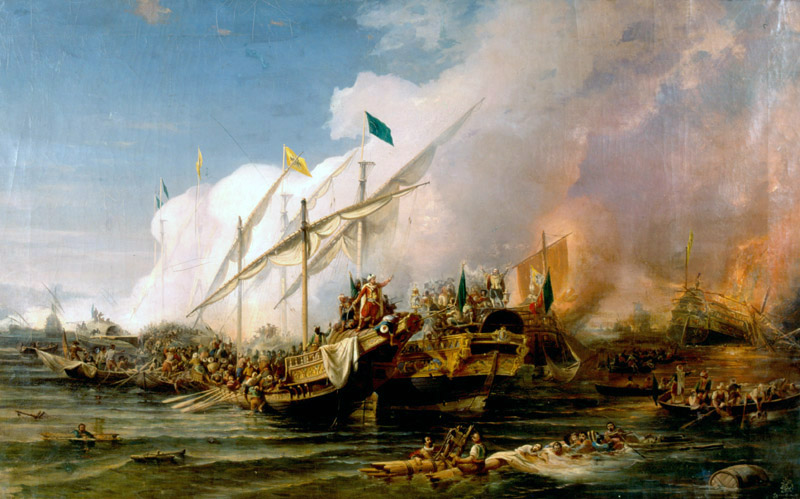
The legacy of Barbarossa would not end there: the younger brother Hizir took up the name of Barbarossa, and retook the city of Tlemcen. The transition was seamless enough that many Europeans did not even realize the first Barbarossa had been killed. (Sort of like the Dread Pirate Roberts.) He secured Ottoman interests in North Africa, and helped defeat the Knights of St John at Rhodes in 1523, where 20 years earlier he had rescued his brother. While Oruc had always had a bit more of an independent streak, Hizir was happy to be a legitimate officer of the Ottoman empire (though he remained governor of Algiers), where he rose to be one of the most senior navel commanders, at his height commanding more than 250 ships and 30,000 soldiers. The Pope organized The Holy League to fight him, consisting of the combined forces of Spain, The Holy Roman Empire, Venice, and the Knights of Malta, but even this force he defeated. Eventually, he would retire in 1545, leaving his son as his successor in Algiers, and a ottoman influence in the region that continues to this day.